How VIN Data Appears Online — and Why It’s So Hard to Take Back Control
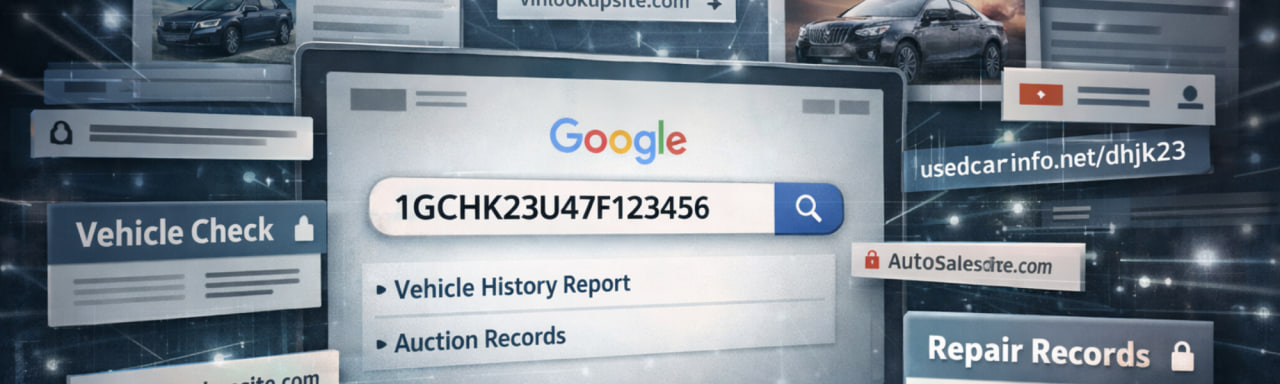
You don’t usually think about your VIN being “online”.
It’s just a number on the car, in the documents — nothing more.
But then one day you Google it. Or someone else does.
And suddenly there are pages you’ve never seen before: old listings, copied reports, auction references, fragments of information that don’t really describe your car anymore.
That’s usually the moment when people start wondering how this data ended up online in the first place — and why it seems almost impossible to fully take it back once it’s there.
How VIN Information Ends Up on the Internet
In most cases, VIN number data online does not come from the vehicle owner. It originates from third parties such as auctions, inspection platforms, logistics services, or resale listings. Once a vehicle appears in one of these systems, its VIN becomes part of a public-facing digital record.
From there, VIN information online is often collected automatically by aggregator websites. These platforms scan open sources and republish vehicle data without checking whether it is still accurate or up to date. Over time, this leads to a situation where VIN history online exists across multiple websites, long after the original source has disappeared.
Why Duplicate VIN Records Keep Appearing
A common problem is the growth of duplicate VIN records online. Even when the information is essentially the same, search engines may index each version separately.
Minor differences — a resized image, rewritten text, or translated page — are enough to create a new indexed result. This is why removing a single page rarely resolves the issue. Once VIN data has been copied, it often continues to circulate independently of the original listing.
What Happens to VIN Data After an Auction
Vehicles that have appeared in auctions are especially exposed. Auction listings usually include detailed photos, condition notes, and VIN references. After the sale, many owners assume this information will eventually disappear.
In reality, auction data is frequently reused by third-party sites. This is why people start looking for ways to remove VIN data after auction or remove auction VIN history. By that point, the auction platform itself is often no longer the primary source of visibility.
Can You Remove VIN History from the Internet?
This leads to one of the most common questions seen in search results: can you remove VIN from the internet?
When people ask whether VIN history can be reduced online, the answer usually depends on where and how the data is indexed. A general explanation of this approach is available on the remove VIN data page.
In short, VIN history is rarely removed at the source — but its online visibility can often be reduced.
What “Removing Car VIN History from the Web” Really Means
Searches like remove car VIN history from the web or delete VIN history often suggest a single action, but the reality is more nuanced. VIN footprints are usually spread across indexed pages, cached results, and mirrored listings.
The realistic goal is not to erase the existence of a vehicle’s past, but to prevent obsolete VIN records from dominating search results. Addressing duplication and outdated references is often enough to significantly reduce unwanted visibility.
VIN Data Cleaning and Privacy Considerations
This is where VIN data cleaning becomes relevant. Rather than hiding information, the focus is on accuracy, proportionality, and relevance. Many vehicle owners are concerned about how long outdated records remain visible and how they affect resale value or trust.
Reducing unnecessary duplication and limiting excessive exposure is part of broader VIN privacy protection. While VINs are standardized identifiers, their online presentation does not always need to remain frozen at a single point in time.
A Realistic Perspective on VIN History Online
If you are researching how to delete VIN history online, it helps to approach the issue with realistic expectations. VIN data spreads easily — especially after auctions — and once replicated, it rarely disappears on its own.
However, outdated and duplicated VIN records do not have to remain permanently visible. Understanding how VIN number data online is created, reused, and indexed is the first step toward reducing its footprint and regaining control over how a vehicle’s history appears in search results.
Write to us to clear your car's history from the Internet
Get a free audit based on your VIN code! Send us the VIN code of your car via messenger.